


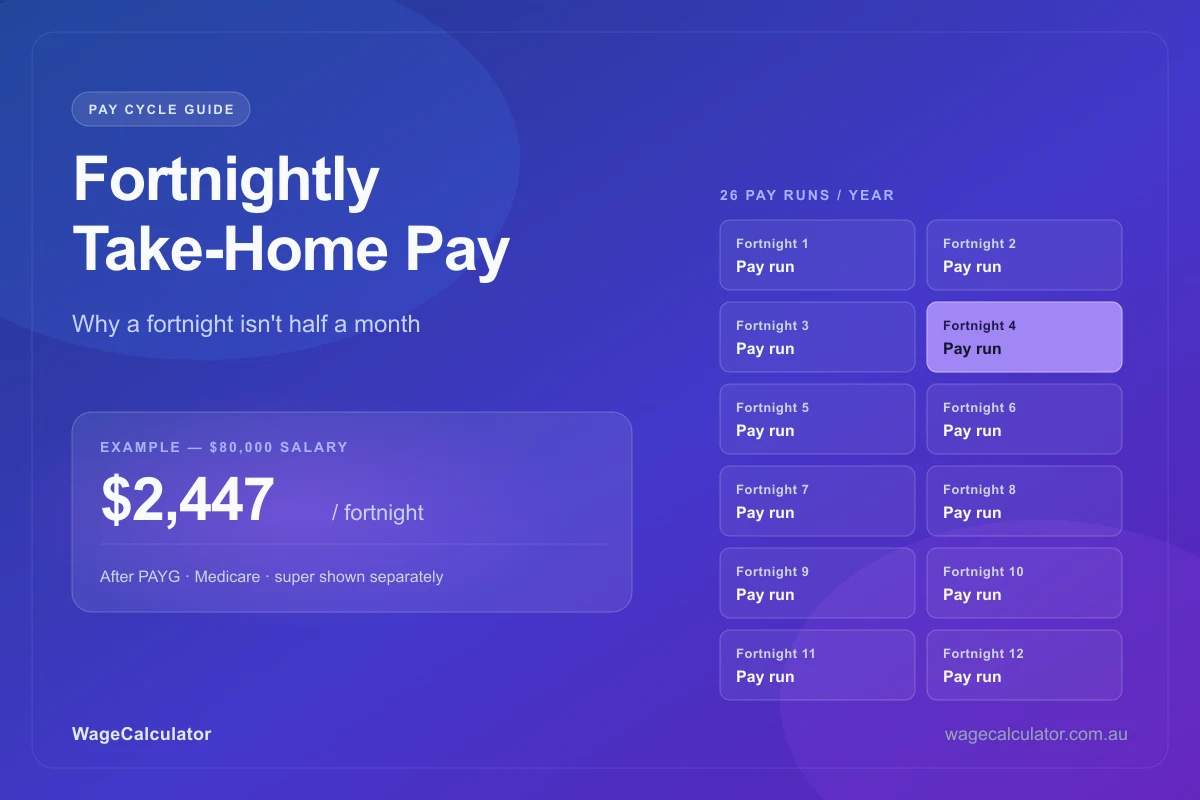
How many fortnights are in a year?
There are 26 fortnights in a year. 26 fortnights of 14 days cover 364 days, so a 26-pay fortnightly cycle leaves one day over in a standard year and two in a leap year. That is why payroll divides an annual salary by 26 to get the fortnightly gross.
| Year | Days | Fortnights | Spare days |
|---|---|---|---|
| Standard year | 365 | 26 | 1 |
| Leap year | 366 | 26 | 2 |
Are there always 26 fortnights in a year?
There are always 26 complete fortnights, but not always 26 fortnightly paydays. The spare day or two each year builds up, so roughly every 11 years a 27th payday falls inside a single financial year. Exactly which year depends on the date your employer's pay cycle started and where leap days land. A 27-pay year changes when you are paid, not your salary — the fortnightly pay calculator shows your annual totals at both 26 and 27 paydays, and the tax catch that comes with the extra pay.
How many pay fortnights are in a financial year?
The same: 26 in most financial years (1 July to 30 June) and 27 in the occasional long year. Your payslips for the year, or your employer's payroll calendar, show which kind of year you are in.
Are there 52 or 56 weeks in a year?
There are 52 weeks in a year, plus one extra day (two in a leap year). 52 weeks is exactly 26 fortnights, which is why weekly pay is your annual salary divided by 52 and fortnightly pay is divided by 26.
How fortnightly pay is calculated
Most Australian employers run payroll on a fortnightly cycle, but salaries are quoted as an annual figure. A quick annualised estimate — close, but not what payroll actually does — starts from that annual salary and works downward in three steps:
- Apply income tax. Your annual gross is run through the ATO's income tax brackets for the financial year, giving annual tax payable.
- Add the Medicare levy and any compulsory HECS/HELP repayment (if your repayment income is above the threshold).
- Divide by 26 for an approximation of the fortnightly net. A real payslip is worked out per pay period from the ATO withholding schedule instead, so it can sit slightly off this annual-÷-26 figure.
In practice, employers don't recalculate each fortnight from scratch — they use the ATO's PAYG withholding schedules. They apply a separate per-period formula and whole-dollar rounding, rather than simply dividing annual tax by 26. Over a full year the withholding is reconciled against the actual assessment when you lodge.
Worked examples by salary, 2026–2027
These figures are worked out per pay period from the 2026–2027 ATO Schedule 1 withholding formulas — the same basis as a payslip — and assume the tax-free threshold is claimed, no HECS debt, and no salary sacrifice. Numbers update automatically each financial year.
| Annual gross | Gross / fortnight | Net / fortnight | Net / week | Net / month |
|---|---|---|---|---|
| $60,000 | $2,308 | $1,934 | $967 | $4,190 |
| $80,000 | $3,077 | $2,455 | $1,227 | $5,319 |
| $100,000 | $3,846 | $2,978 | $1,489 | $6,452 |
| $120,000 | $4,615 | $3,501 | $1,751 | $7,586 |
Fortnightly vs monthly: the math
A common surprise when moving from a monthly to a fortnightly employer: the fortnightly figure looks lower than half the monthly figure. That's not a payroll error — it's the calendar.
- →12 monthly pay runs × 1 month each ≈ 365 days
- →26 fortnightly pay runs × 14 days each = 364 days
A fortnight is just under half a month, so the fortnightly figure (annual ÷ 26) lands a few percent below half the monthly figure (annual ÷ 12 ÷ 2). Over a full year both totals reconcile to the same annual gross — only the per-cycle slice changes. The one wrinkle is the occasional 27-payday year, which changes payment timing but not a fixed annual salary.
How fortnightly pay appears on your payslip
A fortnightly payslip lists the same lines every run: gross pay (annual salary ÷ 26, plus any allowances or overtime), PAYG withheld (income tax + Medicare levy + HECS/HELP via the ATO's fortnightly schedule), any pre-tax deductions such as salary sacrifice, employer super on its own line (it doesn't reduce your take-home), and net pay — the amount that reaches your bank account. To check the PAYG line against the ATO's Schedule 1 formula for any fortnightly gross, use the fortnightly tax calculator. For a worked sample payslip and the full Fair Work field requirements, see the payslips guide, or build one from your own numbers with the payslip generator.
Why your fortnight can change
For a salaried role with no extras, every fortnight should land at the same number. When it doesn't, the usual reasons are:
- HECS/HELP threshold crossed — repayments start once repayment income passes the ATO threshold; the first fortnight after a pay rise can drop noticeably. The HECS repayment calculator shows the annual amount behind that fortnightly deduction.
- Leave loading — where your award, agreement or contract provides it, often at 17.5%, it can lift the gross of a fortnight containing leave hours.
- Allowances and overtime — shift loadings, penalty rates, and on-call allowances change the gross, and therefore the PAYG withheld.
- Salary sacrifice changes — starting or stopping pre-tax deductions shifts both taxable gross and net.
- Voluntary extra withholding — extra tax you've asked payroll to hold back reduces net pay by that amount.
- Back payments and bonuses — a payment that relates to more than one pay period or an undefined period can use the ATO's Schedule 5 method. A payment relating only to one pay period generally uses the ordinary Schedule 1 table.
The bonus tax guide covers the Schedule 5 case in detail, and the HECS/HELP guide covers the threshold-crossing case.
Weekly vs fortnightly vs monthly
Pay-cycle choice usually comes from the employer or industry award, not the employee — but if you have a choice, the practical differences are mostly cash-flow and admin:
| Cycle | Pay runs / year | Best for |
|---|---|---|
| Weekly | 52 | Hourly, casual, and shift work — matches the rostering cycle. |
| Fortnightly | 26 | Most salaried roles in Australia — common for awards and enterprise agreements. |
| Monthly | 12 | Executive, foreign-headquartered, and some professional services roles. |
For budgeting, a fortnightly cycle aligns well with rent and most recurring household bills. For mortgage offset balances, a more frequent cycle (weekly or fortnightly) means money sits in the offset account a few extra days each year.
Frequently asked questions
How is fortnightly take-home pay calculated?
An annualised estimate starts with annual income tax, the Medicare levy and any HELP repayment, then divides the result by 26. A real payslip is different: payroll uses the ATO's per-fortnight Schedule 1 withholding formula, plus the study-loan component when applicable, and rounds each pay. That can differ from annual tax divided by 26; use the fortnightly pay calculator for the payslip-exact estimate.
Why is my fortnightly pay less than half my monthly pay?
There are 26 fortnights in a year but only 12 months, and 12 × 2 = 24, not 26. So a fortnightly figure (annual ÷ 26) is always slightly less than half a monthly figure (annual ÷ 12 ÷ 2). Over a full year both add up to the same total, but your fortnight is shorter than half a month. This catches a lot of people moving from a monthly to a fortnightly employer.
How many fortnights are in a year?
There are 26 complete fortnights in a year. 26 fortnights of 14 days cover 364 days, leaving one spare day in a standard year and two in a leap year. Those spare days add up, so roughly every 11 years a fortnightly pay cycle has 27 paydays in one financial year. Whether that changes the amount paid in that year depends on the employment contract and payroll arrangement; it does not by itself increase a fixed annual salary.
Why is one fortnight smaller than the previous one?
If your fortnightly amount changes between pay runs, the most common causes are: HECS/HELP starting once you cross the income threshold, a salary sacrifice change, an extra day of paid leave (or unpaid leave), a one-off allowance or back payment, or your employer correcting a previous PAYG over-withhold. Salary sacrifice and leave-loading periods are the usual reason a salaried role suddenly shows a different fortnight.
Is fortnightly tax different from weekly or monthly tax?
The annual tax is the same — what changes is the way it's withheld along the way. The ATO publishes a separate PAYG withholding schedule for each cycle (weekly, fortnightly, monthly), each with its own per-period formula and rounding, so the total withheld over a year can land slightly above or below your assessed tax. If you switch from monthly to fortnightly mid-year, any difference resolves at lodgment.
Does fortnightly pay include super?
Usually employer super is paid in addition to salary and does not reduce your fortnightly cash pay. Check your contract, though: a total-remuneration package can include super within the stated package amount. Most payslips show employer super separately so you can see how it has been treated.
Does the ATO fortnightly tax table include HECS?
Not in the base table. The ATO publishes a separate study and training support loans schedule for each pay cycle. When you tell your employer you have a HECS/HELP debt on your tax file number declaration, payroll adds the fortnightly loan component from that schedule on top of the standard PAYG withholding.