


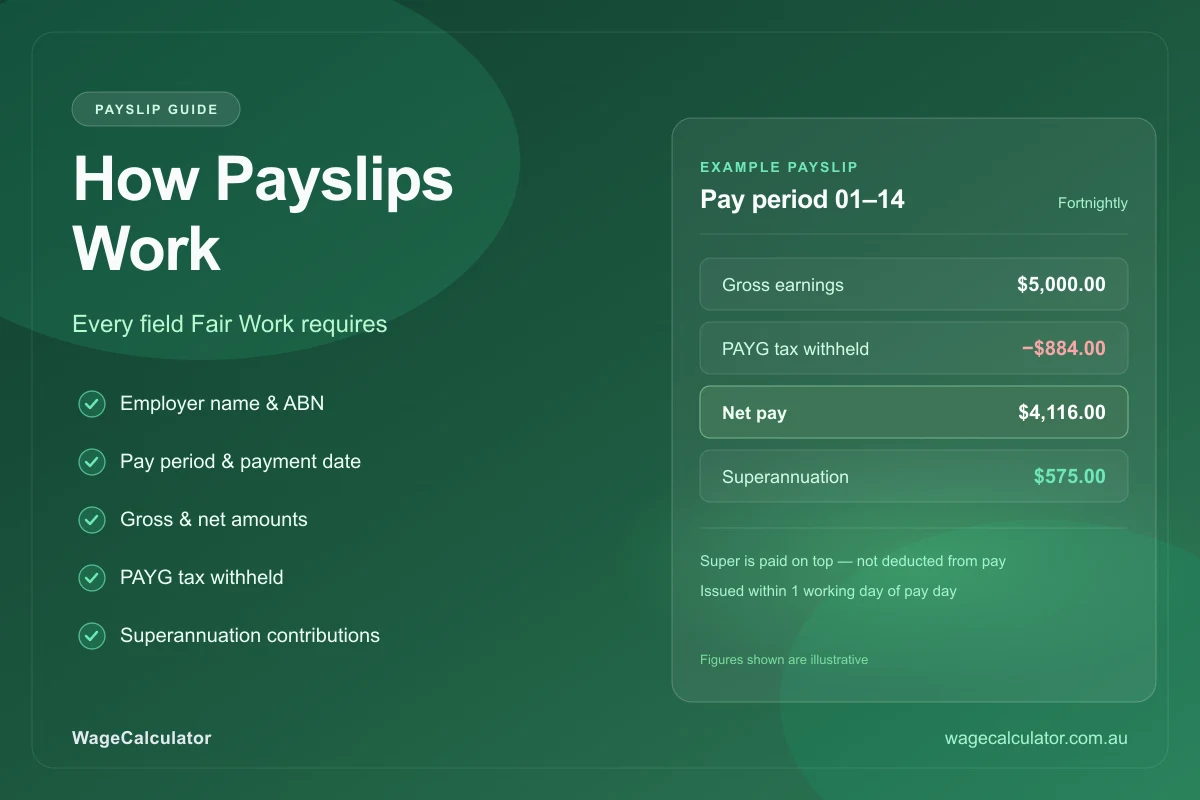
What a payslip is, and why it's required
A payslip is the written record an employer must give an employee for every pay run. Under section 536 of the Fair Work Act 2009 and regulation 3.46 of the Fair Work Regulations 2009, it must be issued within one working day of pay day — printed or electronic — and must contain a defined set of fields.
Beyond compliance, the payslip is how you reconcile what you earned against what you were paid, check PAYG withholding and reported super contributions, and prove income for rental applications, loans, and Centrelink reporting.
Mandatory payslip fields
Every Fair Work-compliant payslip must show:
- Employer name and ABN (if any) — the legal entity paying the employee.
- Employee name, the pay period (start and end dates), and the date of payment.
- Gross & net pay — total earnings before tax, and the final amount paid.
- Hourly rate or salary — for hourly staff, the rate and the number of hours paid at that rate.
- Loadings, allowances and bonuses — itemised separately where their amounts can be separately identified.
- Deductions — PAYG withholding plus any post-tax deductions, each named.
- Superannuation — the contribution amount paid or intended to be paid, and the fund name or number (the Superannuation Guarantee rate is currently 12.0%).
Not required — but common
Leave balances are recommended, not mandatory. Employers must tell you your accrued leave if you ask, but the Fair Work Regulations don't force it onto the payslip itself. Most payroll software prints it anyway.
One exception runs the other way: paid family and domestic violence leave must never appear on a payslip — not the leave taken, not the balance. To protect employee safety, that pay is recorded as ordinary hours or another payment instead.
Source: Fair Work Ombudsman — Pay slips.
A sample fortnightly payslip
Here is how the money lines look for a $85,000 salary paid fortnightly in 2026–2027, with the tax-free threshold claimed and no HECS or salary sacrifice:
| Payslip line | Per fortnight | What it means |
|---|---|---|
| Base salary | $3,269 | Annual salary ÷ 26 fortnights |
| Gross pay | $3,269 | Total earnings before tax this period |
| PAYG withheld | −$682 | Schedule 1 PAYG withholding, remitted to the ATO |
| Net pay | $2,587 | What lands in the bank account |
| Employer super | $392 | 12.0% of qualifying earnings — generally due in the fund within 7 business days of payday |
Most payslips also show a year-to-date column for gross, tax, super and net. Those running totals should reconcile to the income statement your employer reports through Single Touch Payroll. To see these lines for your own salary, use the take-home pay calculator.
Tax, super and HECS on payslips
PAYG tax withheld is the income tax (using the ATO withholding schedule, including its Medicare assumptions) the employer collects each period and remits to the ATO. Super is generally the employer's 12.0% contribution on qualifying earnings. That statutory category includes ordinary time earnings plus specified other payments, including commissions and certain director or labour-contract payments. Under Payday Super, contributions for a pay day generally need to reach the employee's fund within seven business days, subject to limited longer periods. Super is not deducted from net pay, although a total-remuneration contract can include it within the stated package. Source: ATO — qualifying earnings. HECS/HELP repayments, when applicable, often appear as their own withholding line — though some payroll systems fold them into the PAYG total — and are reconciled at tax time. The fortnightly take-home pay guide explains why these withholding lines can change between pay runs.
Electronic vs paper payslips
Either is fine. Most employers email a PDF or publish to a payroll portal — both can comply when the payslip is given within one working day and contains the mandatory fields. Accessible, printable copies are good practice for employees, but are not a separate prescribed field.
Record retention: Employers must keep pay records for at least seven years. Employees should keep their own copies for tax-time reconciliation and proof-of-income requests.
Issuing payslips as a small business
If you pay yourself (or a small number of staff) without payroll software, you still need to issue Fair Work-compliant payslips. The payslip generator helps you produce a PDF containing the required payslip fields. Review the entered details and any award, agreement or contract-specific requirements before issuing it.
If your employer isn't issuing payslips
Not giving payslips — or refusing when asked — breaches the Fair Work Act and can attract civil penalties. Raise it with your employer first; sometimes it's a payroll oversight. If it stays unresolved, the Fair Work Ombudsman can investigate, require back-issue, and issue infringement notices. Keep your own records (bank statements, rosters, time sheets) in the meantime so your hours and pay can still be verified.
Common questions
Is a payslip a legal requirement in Australia?
Yes. Section 536 of the Fair Work Act 2009 requires employers to give every employee a payslip within one working day of pay day, in printed or electronic form — even when the employee is on leave. An employer who refuses can be investigated and penalised by the Fair Work Ombudsman.
How long do I need to keep payslip records?
Employers must keep employee pay records for at least seven years under the Fair Work Regulations. Payslips themselves should be issued to the employee within one working day of pay day, but the employer's record-keeping obligation is the longer one.
Can I issue an electronic payslip?
Yes. A payslip may be given electronically, including by PDF or secure portal, as long as it contains the prescribed information. Making electronic slips easy to access and print is sensible payroll practice, but the legal requirement is the prescribed information and timely provision.
Do leave balances have to be shown on a payslip?
No. Fair Work recommends showing accrued annual and personal leave but does not mandate it on the payslip itself — employers must instead tell employees their balance if asked. Most payroll software prints leave balances anyway, which is why people assume they are compulsory.
What's the difference between a payslip and an income statement?
A payslip covers a single pay period. An income statement (formerly called a payment summary or PAYG summary) is the year-end record your employer reports to the ATO via Single Touch Payroll, viewable in myGov.
How do I show salary sacrifice on a payslip?
Salary sacrifice can change the taxable amount and the way payroll displays earnings. A clear presentation shows the pre-sacrifice earnings and a separately labelled sacrifice line, but Fair Work's payslip rules do not prescribe one universal layout. Check the arrangement, award or agreement and ask payroll to explain any unclear line.
What goes on a final or termination payslip?
A final payslip includes ordinary pay for the period, any unused annual leave paid out, any redundancy or notice payments, and the corresponding PAYG withholding. Employment termination payment (ETP) components are itemised separately and have their own tax rules.
What if my employer isn't giving me payslips?
Withholding payslips is a breach of the Fair Work Act. Raise it with your employer first; if it's unresolved, you can lodge a complaint with the Fair Work Ombudsman, who can investigate and require back-issue.