


TLDR
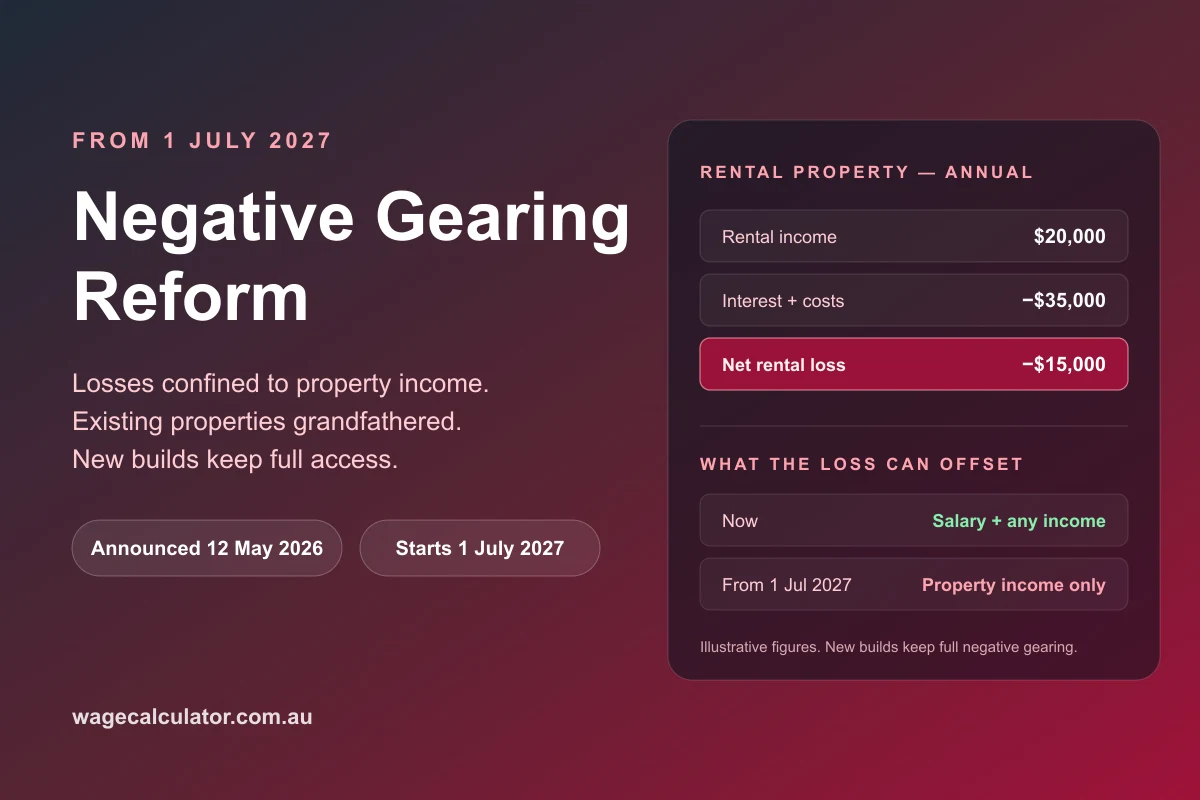
From 1 July 2027, affected residential-property losses can offset residential-property income rather than salary or wages. Properties held at the 12 May 2026 announcement keep current rules. The Act preserves new-build treatment, while detailed eligibility requirements await a Ministerial instrument. The reform was enacted on 26 June 2026.
What Negative Gearing Is
A property is negatively geared when its running costs — loan interest, management fees, maintenance, depreciation — exceed the rent it earns. Say a unit collects $20,000 in rent but costs $35,000 to hold: the investor makes a $15,000 loss. Under the current rules, that loss deducts from their salary, cutting their taxable income and so their tax bill. The investor wears the cash shortfall expecting capital growth to outweigh it at sale.
The 2027 reform doesn't abolish that mechanism — it narrows what the loss can offset. For affected properties the $15,000 loss could no longer reduce salary income; it could only offset other residential property income, including future residential capital gains, carrying forward until used.
Key takeaways for investors
- Losses confined to property income: From 1 July 2027, residential property losses can only offset other residential property income (including capital gains from residential property), not salary or other income.
- Three transitional bands: Properties held at 12 May 2026 keep current rules; properties bought between announcement and 30 June 2027 generally move to the residential-property-loss rules from 1 July 2027, subject to the statutory qualifying-new-residential-dwelling exception; established residential properties bought from then have losses confined to residential-property income.
- New-build pathway preserved: The Act preserves treatment for new residential dwellings, but the operative eligibility requirements are still to be determined by Ministerial instrument.
How the New Rules Work
The reform confines affected residential-property losses to residential-property income. Such losses can offset rent and the relevant residential-property capital gains, but not salary, wages or business income. Excess amounts generally carry forward until residential-property income arises to absorb them; the legislation includes exceptions for bankruptcy and debt-release circumstances.
Which rules apply to a given property depends entirely on when it was acquired — the three transitional bands below. The change interacts with the companion CGT reform at sale, covered in the 2027 CGT reform guide.
Transitional Bands
The reform creates three acquisition windows. Each generally determines whether losses can offset general income or are confined to residential-property income; the statutory qualifying-new-residential-dwelling exception may alter the result, and its detailed eligibility requirements remain pending.
| Acquisition timing | NG treatment | At sale / disposal |
|---|---|---|
| Held at 7:30pm AEST 12 May 2026 (including signed-but-unsettled contracts) | Current NG rules apply — losses offset any income. | Capital gains follow the companion 2027 CGT reform. The property is grandfathered for NG only. |
| Purchased after 7:30pm AEST 12 May 2026, up to 30 June 2027 | Full NG allowed during this window. From 1 July 2027, losses are generally confined to residential-property income, subject to the statutory qualifying-new-residential-dwelling exception. | Excess residential-property losses carry forward; detailed new-dwelling eligibility awaits a Ministerial instrument. |
| Purchased on or after 1 July 2027 (established residential property) | No offset against salary or other income. Losses offset residential property income, with carry-forward subject to statutory exceptions. | New-build pathway is preserved, with detailed eligibility still to be set by Ministerial instrument. |
Source: Budget 2026-27 factsheet — Negative Gearing and Capital Gains Tax Reform (budget.gov.au).
New-Build Exception
The Act preserves an exception for new residential dwellings, but it requires the Minister to determine the eligibility requirements by legislative instrument. The Budget factsheet is useful context for the intended design, not a substitute for the instrument. See the pending-detail discussion in the 2027 CGT reform guide.
Worked Examples
A Treasury cameo and an illustrative transitional-window example show how the bands play out.
Michael — grandfathered existing investor
Michael owns a residential investment property purchased before 12 May 2026. Under the reform, his property is grandfathered — current negative gearing rules continue to apply for as long as he holds it. Any rental losses on this property can still offset his salary and other income, exactly as they do today. If Michael sells the property later, the CGT treatment follows the separate 2027 CGT reform rules.
Source: Treasury cameo, Budget 2026-27 Negative Gearing and CGT Reform factsheet.
Yoonseo — buying in the transitional window
Yoonseo buys an established residential investment property in March 2027 — after the 12 May 2026 announcement but before 1 July 2027. She can negative gear normally during the transitional window. From 1 July 2027, her rental losses can only offset residential-property income, including future capital gains from residential property. Excess losses carry forward to future years and can offset residential-property income whenever it arises. A qualifying new residential dwelling can fall within the statutory exception, but the Ministerial instrument will determine the detailed test.
Illustrative example applying the transitional band rules in the Budget 2026-27 Negative Gearing and CGT Reform factsheet.
What's Not Changing
Super funds (including SMSFs), widely-held trusts and most managed investment trusts, commercial property, shares, and other non-residential asset classes are excluded from these changes.
What Investors Can Do Now
The reform affects different investor profiles differently. Below: what to consider for each. Whichever bucket you're in, state holding costs keep accruing alongside the federal rules — estimate the biggest one with the land tax calculator, since rental losses (where deductible) include land tax.
Existing investors holding pre-12-May-2026 properties
For negative-gearing purposes, a property held before 12 May 2026 remains under the current treatment while you hold it. Separate CGT rules and changes in your own circumstances can still matter, especially if you are considering a sale.
Investors buying after 7:30pm AEST 12 May 2026, up to 30 June 2027
You can negative gear normally during this window. From 1 July 2027, losses on an established property are generally confined to residential-property income. A qualifying new residential dwelling has a statutory exception, but the detailed test awaits a Ministerial instrument; plan cashflow on the assumption losses will not reduce your salary tax bill unless that exception is confirmed.
Prospective buyers from 1 July 2027 (established residential)
Established residential property bought from this date offers no NG against salary. Losses only offset other residential property income, with carry-forward. Re-run yield assumptions before committing.
New-build investors (qualifying new dwellings)
The Act preserves a new-build pathway, but the Ministerial instrument that will set the detailed eligibility requirements has not yet been made. Budget examples describe the policy design only; obtain advice before relying on an exception.
This guide is not financial advice. For material decisions, consult a registered tax adviser.
Sources
- Treasury Laws Amendment (Tax Reform No. 1) Act 2026 — Act No. 49 of 2026 (legislation.gov.au)
- Budget 2026-27 factsheet — Negative Gearing and Capital Gains Tax Reform (budget.gov.au)
- ATO — Reforming negative gearing and capital gains tax
- Parliament of Australia — Treasury Laws Amendment (Tax Reform No. 1) Bill 2026, Bills Digest
Frequently Asked Questions
Is negative gearing being scrapped?
Not entirely. From 1 July 2027, losses from affected residential investment properties can only offset residential-property income (including the relevant capital gains), not salary or wages. Properties held at the 12 May 2026 announcement keep current negative-gearing rules. The Act preserves a new-build pathway, but its detailed eligibility requirements are pending a Ministerial instrument. The reform reshapes how property losses interact with other income — it does not abolish negative gearing.
Is the negative gearing change law yet?
Yes. Treasury Laws Amendment (Tax Reform No. 1) Act 2026 (No. 49, 2026) received assent on 26 June 2026. Schedule 2 contains the negative-gearing changes, with the enacted application and transitional rules described in this guide.
When does negative gearing end?
1 July 2027 is the start date for the new rules. Properties bought between the 12 May 2026 announcement and 30 June 2027 can negative gear normally during that window. From 1 July 2027, those properties can generally only offset losses against residential-property income, with excess losses carrying forward. The statutory exception for a qualifying new residential dwelling must also be considered; its detailed eligibility requirements await the Ministerial instrument.
Can I still negative gear my existing property?
Yes. If you held the property at 7:30pm AEST on 12 May 2026 — including signed-but-unsettled contracts — current negative gearing rules continue to apply for as long as you own it. The grandfathering is property-specific, not investor-specific. A new property bought after the announcement falls under the new rules even if you already own grandfathered properties.
Does this apply to shares?
No. The reform is specific to residential investment property. Share investments, ETFs, managed funds, commercial property, and other non-residential asset classes are unaffected by the negative gearing changes. Capital gains on those assets are subject to the separate 2027 CGT reform, but the loss-offset rules for them don't change.
What is a new build for negative gearing?
The Act preserves a pathway for new residential dwellings, but the detailed eligibility requirements are to be set by a Ministerial legislative instrument. The Budget factsheet described vacant-land construction, higher-density knock-down rebuilds and limited prior occupation as the intended design. Treat those details as policy design until the instrument is made; do not rely on them as a settled legal test.
What happens to my losses?
From 1 July 2027, affected residential-property losses can offset residential-property income, including the relevant residential-property capital gains, rather than salary or other income. Excess amounts generally carry forward until used. The carry-forward rule has exceptions, including bankruptcy and debt-release rules, so obtain advice if those circumstances apply.