


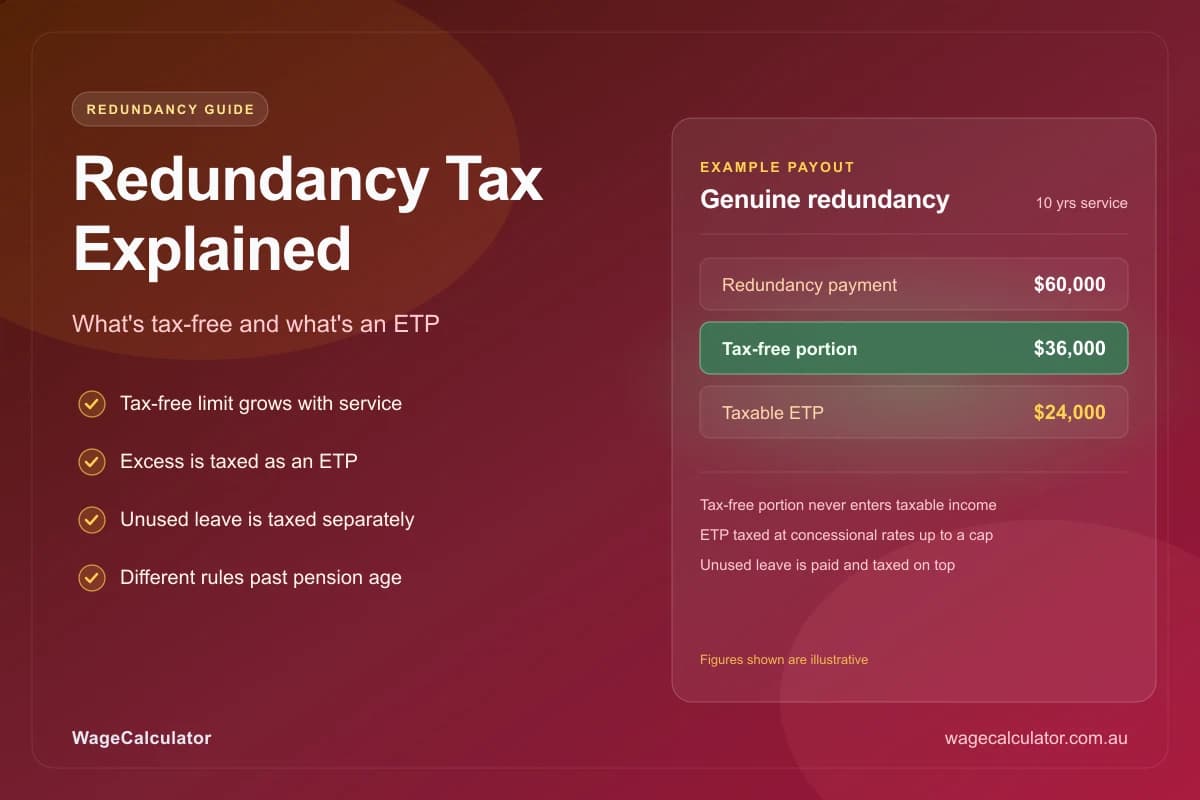
What counts as a genuine redundancy
A redundancy is genuine for tax purposes when your employer decides the job itself no longer exists and dismisses you because of that decision, and you are below the earlier of your Age Pension age (up to 67, depending on date of birth) and your normal or contractual retirement/termination age on the day of dismissal, and there is no arrangement — between you and the employer, or between the employer and any other person — made before the dismissal for you to be employed afterwards. The payment must also exceed what you would reasonably receive on ordinary voluntary termination. The label matters because only the genuine-redundancy component can receive the tax-free limit below.
A final payment can bundle severance, notice-related payments, ordinary wages and leave. Work out the genuine-redundancy component separately: amounts that would have been payable on ordinary termination do not become tax-free merely because the employment ends in a redundancy. How many weeks of redundancy pay an employer owes under the National Employment Standards also depends on coverage and exclusions. The redundancy payout calculator applies it automatically.
Source: ATO — Genuine redundancy payments and Fair Work — Redundancy pay and entitlements.
NES redundancy pay is not universal
The National Employment Standards do not require redundancy pay in every case. Small-business employers, casual employees, employees with less than the required service and other excluded categories can be outside the NES entitlement. An award, enterprise agreement or contract can still provide different benefits.
The tax-free limit
Every genuine redundancy payment is tax-free up to a limit set by a simple formula: a base amount plus a service amount for each complete year you worked for that employer. For 2026–2027 the base amount is $13,598 and the service amount is $6,801 per year. Both are indexed to wages growth on 1 July each year.
Example: after 8 complete years of service, the 2026–2027 tax-free limit is $13,598 + ($6,801 × 8) = $68,006. A payout at or under that figure is entirely tax-free — it does not even appear in your assessable income.
Part years do not count toward the service amount. Apply the limit to the genuine-redundancy component after separating wages, leave and other amounts that have their own tax treatment; do not assume every notice-related payment is part of that component.
How the excess is taxed (ETP)
The amount of the genuine-redundancy component above the tax-free limit is generally an employment termination payment — a lump sum taxed at flat concessional rates instead of your marginal rate. The rate depends on your age, and the concession runs out at the ETP cap ($270,000 in 2026–2027).
| Portion of the taxable ETP | Your age | Withholding rate |
|---|---|---|
| Up to the ETP cap | Under preservation age (60) | 32% |
| Up to the ETP cap | Preservation age or over | 17% |
| Above the ETP cap | Any age | 47% |
The rates include the Medicare levy, and your employer withholds them before the money reaches you — there is no separate bill later unless other parts of your return change the picture.
Source: ATO — Schedule 11 tax table for ETPs.
Worked example: a $100,000 payout
Take a $100,000 genuine redundancy payment after 8 complete years of service, aged 45, in 2026–2027:
- Tax-free limit: $13,598 + ($6,801 × 8) = $68,006
- Taxable ETP: $100,000 − $68,006 = $31,994
- Tax withheld at 32% (under preservation age): $10,238
- In your bank: $89,762 — an effective rate of about 10.2% on the whole payout
The same payout at preservation age or older would be withheld at 17% on the excess instead. To run your own scenario, use the redundancy payout calculator.
Genuine vs non-genuine redundancy
A payment is non-genuine when you resign voluntarily, leave at the end of a contract, are dismissed for performance or disciplinary reasons, or have reached the earlier of their Age Pension age and their normal or contractual retirement/termination age on dismissal. A voluntary redundancy still qualifies as genuine when the employer abolishes the role — volunteering for it does not disqualify you.
A payment that is not genuine loses the genuine-redundancy tax-free limit. Its relevant termination-payment component may be an ETP; ordinary wages and unused leave remain separately taxed. Non-redundancy ETPs can also face the whole-of-income cap of $180,000, which is reduced by every dollar of other taxable income you earn in the same year — so a mid-year termination with months of salary already paid can push a large slice of the payment to the 47% rate.
Source: ATO — Genuine redundancy payments.
Leave, super and HECS
Three side rules catch people out. First, unused annual leave and most unused long service leave paid out on a genuine redundancy are dealt with under the Schedule 7 withholding treatment, including the 32% rate where it applies. Long service leave accrued before 16 August 1978 can have different Lump Sum B treatment. These amounts sit outside both the tax-free limit and the ETP component. Second, no superannuation is payable on redundancy pay, ETPs, or leave payouts, because none of them are qualifying earnings — the Superannuation Guarantee base from 1 July 2026 — with one exception: payment in lieu of notice substitutes for ordinary hours you would have worked, so it does attract super.
Third, while the tax-free portion never enters your tax return, the taxable ETP and leave payments are assessable income — they can push your repayment income over a HECS/HELP threshold and trigger a compulsory repayment at assessment. The HECS/HELP repayment guide explains how repayment income is built, and the tax refund guide covers how the year reconciles.
Source: ATO — Schedule 7 tax table for unused leave on termination.
Frequently asked questions
Is redundancy pay taxed in Australia?
Partly. The genuine redundancy component is tax-free up to a limit based on your years of service — for 2026–2027 the limit is $13,598 plus $6,801 for each complete year. The amount of that genuine redundancy component above the limit is generally an employment termination payment (ETP). Wages, unused leave and other final-pay items are assessed under their own rules rather than being folded into the redundancy amount.
How much of a redundancy payout is tax-free?
The tax-free limit is a base amount plus a service amount for each complete year with that employer. In 2026–2027 that is $13,598 + ($6,801 × years of service). After ten complete years the tax-free limit reaches $81,608, which covers many redundancy payouts entirely. Both amounts are indexed on 1 July each year.
What is an employment termination payment (ETP)?
An ETP is a lump sum paid in consequence of employment ending, subject to statutory inclusions and exclusions. The amount of a genuine redundancy payment above its tax-free limit can be an ETP, as can certain other termination payments. It is not a label for every amount on a final payslip: unused leave and ordinary wages are treated separately. ETP rates and caps depend on the payment type, age and relevant cap.
What tax rate applies above the tax-free limit?
The excess is an ETP. If you are under preservation age (currently 60), your employer withholds 32%; at or above preservation age the rate drops to 17%. Those rates apply up to the ETP cap ($270,000 in 2026–2027); any amount above the cap is withheld at 47%, the top marginal rate including the Medicare levy.
Is super paid on redundancy payments?
Generally no. Redundancy pay, ETPs, and unused leave paid out on termination are not qualifying earnings — the Superannuation Guarantee base from 1 July 2026 — so the superannuation guarantee does not apply to them. Your employer must still pay super on your normal earnings up to your final day, including any notice period you work. If you are paid in lieu of notice, that payment in lieu does attract super because it substitutes for ordinary hours you would have worked.
Is voluntary redundancy taxed the same as forced redundancy?
Usually, a voluntary redundancy can still be genuine when the employer has decided the role is no longer required and the tax conditions are met. The employee must be dismissed before the earlier of their Age Pension age and their normal or contractual retirement/termination age, there must be no arrangement for re-employment, and the payment must exceed what would reasonably be expected on ordinary voluntary termination. Ordinary resignation, performance dismissal or an ordinary retirement payment do not qualify for the genuine-redundancy tax-free treatment.
How is unused annual leave taxed on redundancy?
Unused annual leave and most unused long service leave paid on a genuine redundancy are subject to the Schedule 7 withholding treatment, including the 32% rate where it applies. They sit outside the genuine-redundancy tax-free limit and are separate from the ETP component. Long service leave accrued before 16 August 1978 can receive different Lump Sum B treatment, so check the payment summary rather than assuming one rate applies to every leave amount.
What happens if I am made redundant after Age Pension age?
A payment cannot qualify for the genuine-redundancy tax-free limit once the employee has reached the earlier of their Age Pension age and their normal or contractual retirement/termination age. Age Pension age is not the only test, and its current maximum is 67 depending on date of birth. The relevant termination-payment component may instead be an ETP, while wages and unused leave remain separate final-pay items. ETP treatment depends on the type of payment and the applicable cap; being over preservation age can affect the concessional rate, but it does not turn every amount in the final payment into an ETP.