


TLDR
From 2026–2027 the ATO applies a work-related deduction of up to $1,000 automatically — no claim, no receipts, no spending required. It is a top-up rather than a bonus: anything you claim for work expenses is subtracted from it, so your total work-related deduction is whichever is higher. Donations, personal super and rental costs still stack on top as normal.
What It Is
The standard deduction for work-related expenses is a fixed deduction every eligible worker gets without substantiating anything. It was inserted into the tax law as section 25-130 of the Income Tax Assessment Act 1997 and applies to assessments for 2026–2027 and later years.
It is a deduction, not a rebate or an offset. It comes off your taxable income before the brackets are applied, so what it is actually worth depends on your marginal rate — the same $1,000 saves a top-rate earner more than someone in the lowest taxed band, and saves nothing at all for someone earning under the tax-free threshold.
Why It Is Automatic
This is the part most people get wrong, because it does not behave like any other deduction. There is no box to tick and no election to make. If you are eligible, the ATO applies the deduction to your assessment whether or not you do anything — the law says you deduct the amount, not that you may choose to.
That also means it is not a shortcut you opt into instead of itemising. Both paths exist at once, and the law works out which leaves you better off. The next section explains how.
A Top-Up, Not a Bonus
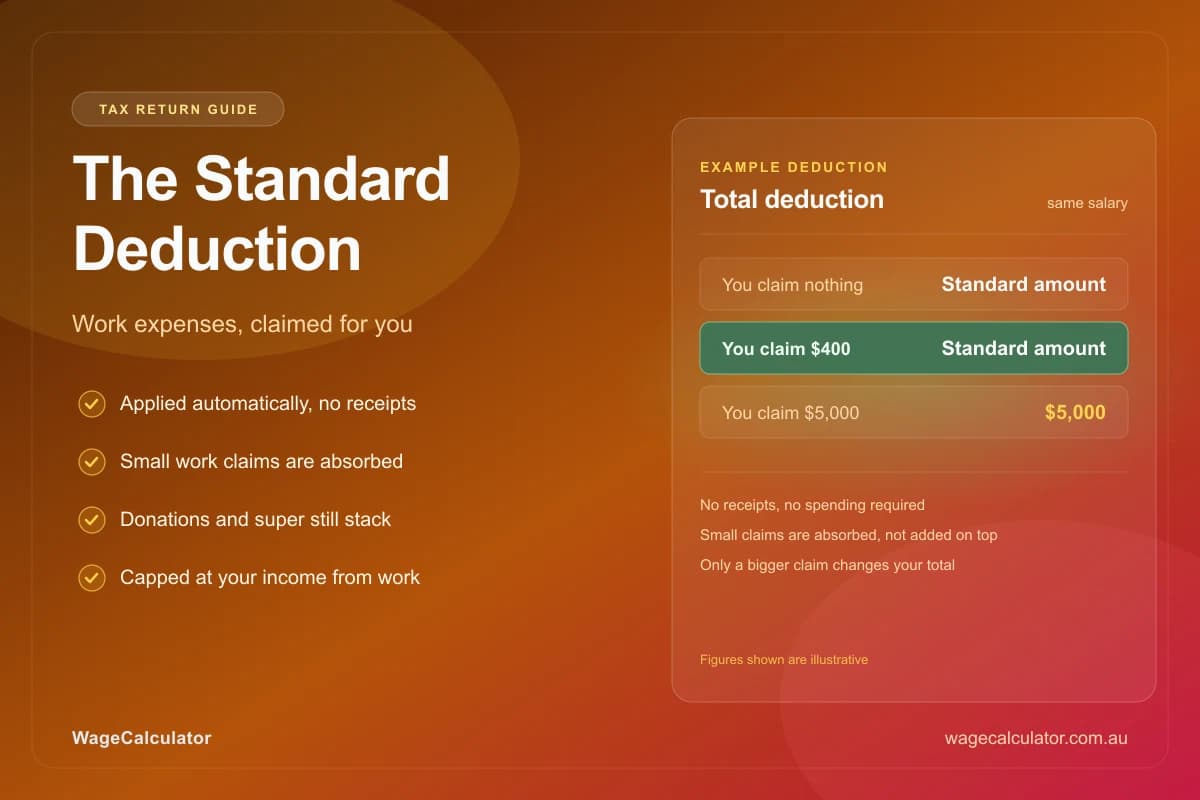
The standard amount is reduced — never below zero — by the work-related expenses you claim. Claim $400 of work expenses and the top-up shrinks by $400; claim more than the standard amount and the top-up disappears entirely and your actual claims stand on their own. The effect is that your total work-related deduction is always the higher of the two, never the sum.
The practical consequence: entering small work expenses changes nothing. It is only worth gathering records once your genuine work-related costs are clearly above $1,000 for the year.
Worked Example
Three scenarios on a $80,000 salary. Note that the first two produce an identical total — and therefore an identical tax bill.
| What you claim | Entered claims | Standard top-up | Total work deduction |
|---|---|---|---|
| Claim nothing | $0 | $1,000 | $1,000 |
| Claim $400 of work expenses | $400 | $600 | $1,000 |
| Claim $2,000 of work expenses | $2,000 | $0 | $2,000 |
On this salary, with no HELP debt and private hospital cover held, the deduction is worth about $320 a year in tax and levy — the standard amount multiplied by the marginal rate that applies to it. Run your own figures in the tax return calculator, which always applies the deduction, or in the pay calculator, where take-home defaults to the payslip view and a switch turns the deduction on.
It Also Moves HELP and the Surcharge
The worked example above deliberately holds two things constant, and both of them can make the deduction worth more than the headline figure. Compulsory HELP repayments are worked out on repayment income, which starts from taxable income — so the same $80,000 salary with a study debt saves about $470 rather than $320, with roughly $150 of that coming off the repayment. The deduction can also drop repayment income under the threshold entirely, in which case the whole compulsory repayment disappears for the year.
The Medicare levy surcharge works the same way. It is charged on income for surcharge purposes, which also starts from taxable income, so someone without private hospital cover sitting just above the $105,000 single threshold can be pushed back under it. The surcharge is a percentage of the whole income rather than of the amount above the line, so crossing back under removes all of it — far more than the deduction is worth in income tax alone. Both effects are modelled in the tax return calculator, and in the pay calculator once the standard-deduction switch is turned on.
Who Gets It
Three conditions: you are an individual, you were an Australian resident at some point during the income year, and you earned income from work. Work income here means amounts your payer has to withhold from — salary and wages, directors' fees, payments to office holders and religious practitioners, return-to-work payments, termination payments and parental leave pay.
The deduction is also capped at that assessable labour income, so it cannot manufacture a loss. Someone who earned a few hundred dollars from a short stint of employment gets only what they earned, not the full standard amount. Sole-trader business income and personal services income also do not count for this deduction, nor do partnership or trust distributions, rent, dividends or capital gains. The Act uses those business and personal-services amounts in separate working Australians tax offset rules; that does not expand the standard-deduction test in section 25-130.
Deductions the standard amount does not absorb
- Gifts and donations to deductible gift recipients.
- Personal super contributions you claim a deduction for.
- Income protection, sickness and accident premiums — expressly carved out of the reduction rule.
- Trade, business or professional association fees — also expressly carved out.
- Rental property expenses and other investment-related deductions.
- The cost of managing your tax affairs, including registered tax agent fees.
Each of these reduces your tax from the first dollar, on top of the standard amount. It is only the work-related list — general work deductions, car expenses, travel between workplaces, repairs and depreciation on work assets — that erodes the top-up.
What Changed for Receipts
The standard deduction did not arrive alongside the old no-receipt concessions — it replaced them. The exception that let you claim a small total of work expenses without written evidence, and the separate laundry concession, were both repealed from 2026–2027.
What is left is three tiers rather than two. The standard amount needs nothing at all — no spending, no receipts, no log. The statutory rate methods are unchanged, but none of them is evidence-free: the fixed rate for working from home needs a record of every hour worked from home across the year and at least one bill for each running cost the rate covers, and cents per kilometre needs a record of how you reached your kilometre figure, though no receipts for the car costs themselves. Everything else claimed as an actual expense needs written evidence for the whole claim — not just the portion above the standard amount.
Records are still worth keeping through the year: you cannot know in advance whether an unexpected work cost will push your total above the line.
Why Your Payslip Differs
PAYG withholding schedules do not account for the standard deduction. Your employer withholds as though it does not exist, so the benefit lands at lodgement rather than in each pay. Over a full year that is a small over-withholding — on a $80,000 salary with no study debt, about $320 that comes back as a larger refund or a smaller amount owing.
It also explains a gap you may notice between calculators. An annual take-home figure that applies the deduction sits slightly above twelve months of payslips, and above tools that leave the measure out entirely. Take-home figures on this site deliberately leave it out so they stay comparable with your pay — the pay calculator has a switch that applies it, and the tax return calculator uses it throughout, because a return is an annual assessment.
Sources
- Treasury Laws Amendment (Tax Reform No. 1) Act 2026 — Schedule 4 inserts ITAA 1997 s 25-130 and repeals the earlier substantiation exceptions.
- ATO — Standard deduction for work-related expenses
Frequently Asked Questions
What is the standard deduction for work-related expenses?
It is an automatic work-related deduction of up to $1,000 that the ATO applies to eligible taxpayers from 2026–2027. You do not claim it, you do not need receipts, and you do not need to have spent the money. It reduces your taxable income like any other deduction — it is not a rebate or a tax offset, so what it is worth to you depends on your marginal rate.
Do I have to claim the standard deduction?
No. It applies automatically if you are eligible, which is why it is described as a default rather than a claim. You do not tick a box, and there is nothing to elect. If you lodge without entering any work-related expenses at all, the deduction is still in your assessment.
Can I claim work expenses on top of the standard deduction?
Not work-related ones. The standard amount is reduced by the work-related expenses you claim, so your total work-related deduction is whichever is higher — never the two added together. Claiming $400 of work expenses leaves you with exactly the same total as claiming nothing. Only once your genuine work claims exceed the standard amount does entering them change your outcome.
Which deductions still stack on top?
Deductions outside the work-related list are unaffected and are claimed as normal: gifts and donations to registered charities, personal super contributions you claim a deduction for, income protection, sickness and accident insurance premiums, trade or professional association membership, rental property expenses, and the cost of managing your tax affairs. These change your refund from the first dollar.
Who is eligible for the standard deduction?
You must be an individual, an Australian resident at some point during the income year, and derive assessable labour income — salary and wages, directors' fees, office-holder payments, termination payments or parental leave pay. The deduction is capped at that withholding income, so someone who earned less than the standard amount is limited to what they earned. Sole-trader business income, personal services income and partnership or trust distributions do not count for this deduction. Those amounts have separate treatment in the later working Australians tax offset rules.
Can I still claim $300 of work expenses without receipts?
Not from 2026–2027. The old exception that let you claim a small total of work expenses without written evidence — and the separate laundry concession — were repealed when the standard deduction was introduced. If you claim actual work expenses instead, you need written evidence for the whole claim, not just the part above the standard amount. The statutory rate methods are unchanged, but they are not evidence-free either: the fixed rate for working from home needs a record of every hour worked from home across the year plus at least one bill for each running cost the rate covers, and cents per kilometre needs a record of how you worked out your work kilometres, though no receipts for the car costs. The standard deduction is the only path that needs no records at all.
Does my take-home pay estimate include the standard deduction?
Not by default. PAYG withholding schedules do not include the standard deduction, so your employer withholds as though it is not there and the difference comes back when you lodge. Take-home figures across this site follow withholding for that reason, which keeps them comparable with your payslip; the pay calculator has a switch that includes the deduction, and the tax return calculator always applies it. Any annual take-home figure that includes it sits slightly above twelve months of payslips added together.
How much is the standard deduction worth?
It reduces your taxable income by up to $1,000, so the core cash value is that amount multiplied by your marginal rate plus the Medicare levy. On a $80,000 salary with no HELP debt and private hospital cover, that is roughly $320 a year. It can be worth more than that: a lower taxable income also means lower HELP repayment income and a lower income figure for the Medicare levy surcharge. The same $80,000 salary with a HELP debt saves about $470, because the compulsory repayment falls by another $150. Income below the tax-free threshold makes it worth nothing, because there was no tax to reduce.