


How GST works in a business
Once your business is registered for GST, you include GST at 10% in the price of most things you sell. On your business activity statement (BAS) you report that GST, claim back the GST in your business purchases as GST credits, and pay the ATO the difference.
Calculating GST in a business is therefore three jobs: the GST in each sale, the credits in each purchase, and the net amount for the period. The arithmetic for a single price is the easy part; the GST calculator does it in one step. The rules below decide which sales carry GST, which purchases earn a credit, and where each figure goes on your BAS.
Source: ATO — Taxable sales.
When you must register for GST
You must register within 21 days of your GST turnover reaching $75,000. GST turnover is your business income, not your profit, less the GST in your sales, input-taxed sales and a few other items. Check it two ways each month: current turnover (this month plus the previous 11) and projected turnover (this month plus the next 11). Reaching the threshold on either test means you must register, unless the ATO is satisfied your projected turnover will stay below it.
Non-profit organisations have a higher threshold. Taxi, limousine and ride-sourcing drivers must register whatever they earn, as must any business claiming fuel tax credits. You need an ABN first. Below the threshold registration is optional, but once registered you generally stay registered for at least 12 months.
Registering late can be costly: you may have to pay GST on sales made since you were required to register, even though your prices did not include it, plus penalties and interest.
Source: ATO — Registering for GST.
Taxable, GST-free and input-taxed sales
Once you are registered, or required to be, every sale you make in Australia is a taxable sale unless it is GST-free or input-taxed. A taxable sale is made for payment, in the course of your business, and is connected with Australia. Selling a business asset, such as a car or office equipment, usually counts too.
| Sale type | GST in the price? | Credits on related purchases? | Examples |
|---|---|---|---|
| Taxable | Yes, at 10% | Yes | Most goods and services, and business assets you sell |
| GST-free | No | Yes | Most basic food, some education and health services, exports |
| Input-taxed | No | No | Financial supplies such as lending; selling or renting out residential premises |
If one sale mixes taxable and non-taxable parts, GST applies only to the taxable part, so work it out item by item rather than on the invoice total. Input-taxed sales are also left out of your GST turnover.
Source: ATO — GST-free sales and ATO — Input-taxed sales.
Quoting prices with or without GST
The ACCC says a price displayed to consumers must be the total price as a single figure, including GST and any unavoidable fees. Displays aimed only at other businesses are exempt. When you quote another business, say plainly whether the figure includes GST, so the buyer knows the total.
Example: A quote of $2,000 plus GST adds $200 of GST, for a total of $2,200. If the same $2,000 is charged as the full price, the GST is already inside it: $2,000 ÷ 11 = $181.82, leaving you $1,818.18.
To set a GST-inclusive price, start from the total you want to charge and remove GST from the price to see what you keep.
Source: ACCC — Price displays.
What a tax invoice must show
If a customer asks for a tax invoice, you must provide one within 28 days, unless the sale is $82.50 or less including GST. For a taxable sale under $1,000, it must show:
- that it is intended to be a tax invoice
- your identity and your ABN
- the date it was issued
- a brief description of each item, with quantity and price
- the GST amount, or, if the GST is the total ÷ 11, the words “Total price includes GST”
- how far each item is a taxable sale
Sales of $1,000 or more must also show the buyer's identity or ABN. A PDF sent by email is a valid tax invoice if it contains all of the above. Where an invoice has only one taxable sale, round GST to the nearest cent, rounding half a cent up.
Source: ATO — Tax invoices.
Claiming GST credits on purchases
You can claim a GST credit when you buy something for your business, the price included GST, you have paid or must pay for it, and it does not relate to input-taxed sales. For a purchase over $82.50 including GST you need a tax invoice before you claim; at or below that, a receipt, docket or invoice is enough.
If an invoice only says the price includes GST, the credit is the price ÷ 11. For something used partly privately, claim only the business share: a $440 phone used half for business carries $40 of GST, so the credit is $20.
Check that suppliers are registered for GST on ABN Lookup, and claim within the 4-year time limit. On a cash basis you claim in the period you pay; on an accruals basis, in the first period you are invoiced or pay, as long as you hold any tax invoice you need.
Reporting GST on your BAS
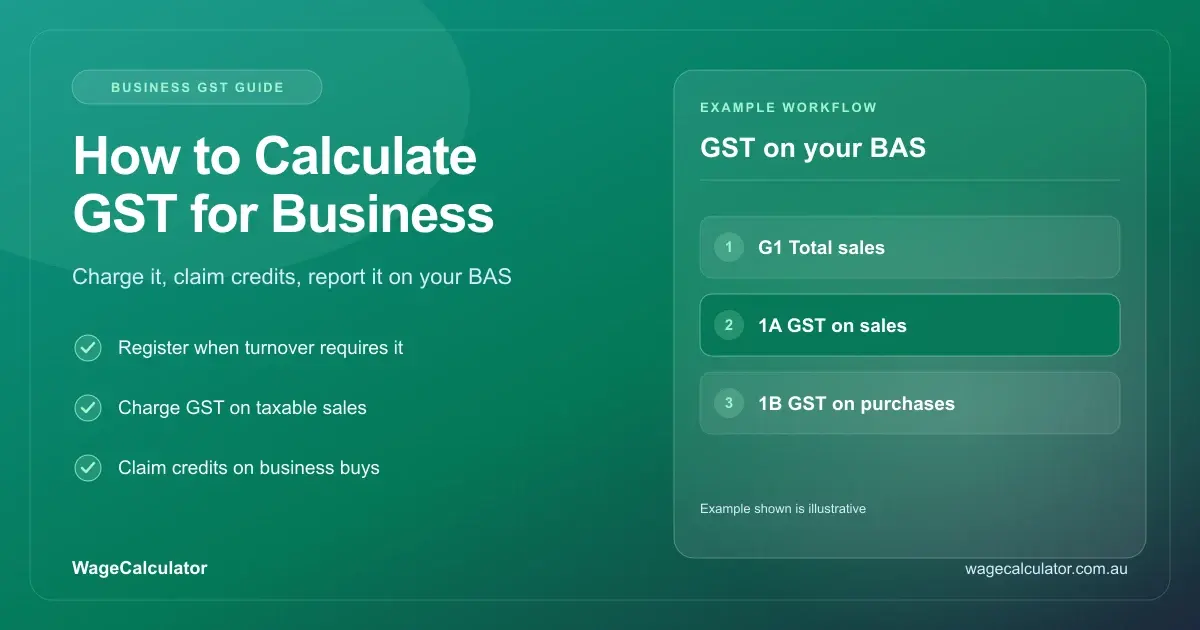
Small businesses report GST on the BAS at three labels: G1 total sales, 1A GST on sales and 1B GST on purchases. The GST you pay is 1A minus 1B; when your credits are larger you have a net credit, which the ATO generally refunds or offsets against other amounts you owe. G1 can include or exclude GST, but you tick a box to say which.
| BAS label | Working | Amount |
|---|---|---|
| G1 Total sales | GST-inclusive, box ticked | $33,000 |
| 1A GST on sales | $33,000 ÷ 11 | $3,000 |
| 1B GST on purchases | $11,000 ÷ 11 | $1,000 |
| GST to pay | 1A minus 1B | $2,000 |
Most small businesses report and pay quarterly; very large ones must report monthly, and businesses registered voluntarily below the threshold can report annually. To total a batch of invoice lines or estimate your GST position for a period, use the calculator's bulk mode and BAS helper.
Source: ATO — Choose a method to complete your BAS, ATO — Simpler BAS and ATO — When and how to report and pay GST.
Frequently asked questions
How do I work out the GST I owe for a quarter?
Add up the GST in your taxable sales for the period, which goes at label 1A, and the GST credits in eligible business purchases, which go at 1B. The GST you owe is 1A minus 1B; if 1B is larger, you have a net credit, which the ATO generally refunds or offsets against other amounts you owe. When a sale is recorded including GST, the GST in it is the price divided by 11. Count only sales and purchases that belong to the period under your accounting basis: on a cash basis when paid, on an accruals basis when first invoiced or paid.
How long do I have to register once I reach the GST threshold?
You have 21 days from when your GST turnover reaches $75,000 on either the current or the projected test, so check it each month while you are below it. One exception: if your current turnover reaches the threshold but the ATO is satisfied your projected turnover will stay below it, you don't have to register. You need an ABN first, and you can register through Online services for business, by phone, or through a registered tax or BAS agent. If you register late, you can ask the ATO to backdate the registration by up to 4 years, and GST may be payable on sales made since the date you were required to register.
Do I charge GST if my business isn't registered?
No. Only a business that is registered for GST, or required to be, makes taxable sales with GST in the price. If your GST turnover stays below $75,000 and you are not in an industry that must register, such as taxi or ride-sourcing, you can stay unregistered and add no GST, but you can't claim GST credits either. If you reach the threshold and don't register, you may have to pay GST on sales made since you were required to register, even though your prices didn't include it.
Do GST-free sales count towards GST turnover?
Yes. GST turnover is your total business income, not your profit, less the GST in your sales, input-taxed sales, sales not connected with Australia or with your business, and unpaid non-taxable sales to associates. GST-free sales are not on that list, so a business selling mainly basic food can still pass $75,000 and need to register. Projected turnover also leaves out the sale of capital assets and sales made because you are closing or shrinking the business.
What is the difference between GST-free and input-taxed sales?
Neither has GST added to the price. The difference is on the purchase side. With GST-free sales, such as most basic food, some health services and exports, you can still claim credits for the GST in the purchases you used to make them. With input-taxed sales, mainly financial supplies and selling or renting residential premises, you can't claim those credits. Input-taxed sales are also left out of your GST turnover, while GST-free sales count towards it.
Do I need a tax invoice to claim a GST credit?
For a purchase over $82.50 including GST, yes: hold a valid tax invoice before you claim, even if that moves the claim into a later period. Your supplier must provide one within 28 days of your request. For purchases of $82.50 or less, a receipt, cash register docket or invoice is enough. If you have none of those, record the supplier's name and ABN, the date, what you bought and the amount paid.
Should my prices include or exclude GST?
Prices you display to consumers should be the total price as a single figure, including GST and any unavoidable fees, which is the ACCC's rule for advertised prices; displays aimed only at other businesses are exempt. When you quote another business, say plainly whether the figure includes GST so the buyer knows the total. On the tax invoice itself, either show the GST amount separately or, when every item is taxable, state that the total price includes GST. Once you are registered, a taxable sale charged without GST added still has GST inside the price, so you bear it.