


Shift loadings vs penalty rates
A shift loading is a percentage added to your ordinary hourly rate for working a defined shift type — afternoon, night or rotating rosters. A penalty rate is a higher rate for working penalty times: weekends, public holidays, or early and late hours outside the ordinary span. Casual loading is a third member of the family — a percentage that compensates casuals for the paid leave and notice they do not receive. Shift loadings and penalty rates come from your award or enterprise agreement; casual loading comes from the same place, or from the National Minimum Wage Order if no award or agreement covers you. All three are ordinary taxable income, taxed exactly like base pay.
Since a 2025 amendment to the Fair Work Act, the Fair Work Commission must not reduce award penalty or overtime rates, or accept award terms that substitute them in ways that cut the additional pay they provide — so these entitlements are anchored in the award safety net. You can work out the gross value of your loadings and penalties from your roster before looking at the tax side.
17.5% leave loading is a different thing
Annual leave loading — commonly 17.5% — is paid on top of your base rate while you are on paid annual leave, not for working shifts. It is taxed at normal marginal rates too. The annual leave calculator covers how it is worked out.
Source: Fair Work — Penalty rates and Fair Work — Allowances and penalty rates.
Rotating vs permanent night shift loadings
Awards that set shift loadings usually pay a lower percentage for afternoon or rotating night shifts and a higher tier for permanent night work, on the reasoning that a fixed night roster carries a larger ongoing health and social cost. The tiers are award-specific — some awards have no permanent-night tier at all:
| Award | Afternoon shift | Night shift | Permanent night |
|---|---|---|---|
| Nurses Award (MA000034) | 12.5% | 15% | — |
| SCHADS Award (MA000100) | 12.5% | 15% | — |
| Manufacturing Award (MA000010) | 15% | 15% | 30% |
Four cautions when reading your own award. Loadings here are amounts on top of the rate each award treats as its base; the same entitlements are often published as all-inclusive rates (a 30% loading equals a 130% rate) — never add one to the other. Loadings do not stack with weekend or public holiday penalties either: these awards pay the higher penalty in substitution for the shift loading, not on top of it. One-off shifts can be priced differently — the Manufacturing Award pays non-successive night shifts at overtime-style rates instead of the loading. And each instrument scopes its own coverage: the Nurses Award excludes its senior registered nurse levels, and enterprise agreements frequently replace these clauses entirely. The instrument that covers you is the authority — not the table above, and not what a payslip happens to show, since a payslip records what was paid rather than what was owed.
Sources: Nurses Award cl 20.2, SCHADS Award cl 29.3, Manufacturing Award cl 33.2, via Fair Work — Pay and wages.
Casual loading and tax
The standard casual loading is 25% of the base rate — the figure set by the National Minimum Wage Order for award-free employees and used by awards such as SCHADS, though enterprise agreements can set a different loading. For tax it is simply wages: the loading is withheld and taxed with the rest of your pay at your marginal rate, with no concession and no penalty. Being casual does not put you on a different tax scale.
Where casuals do need to read the award closely is the interaction with penalty rates. Some awards add the casual loading and the weekend penalty separately; others publish one combined casual rate that already includes the loading — the Retail Award's casual evening, Sunday and public holiday rates are stated that way. The combined-rate form is why two casuals on similar base rates can see different Sunday pay.
Source: Fair Work — Casual employees.
Do you pay more tax on penalty rates?
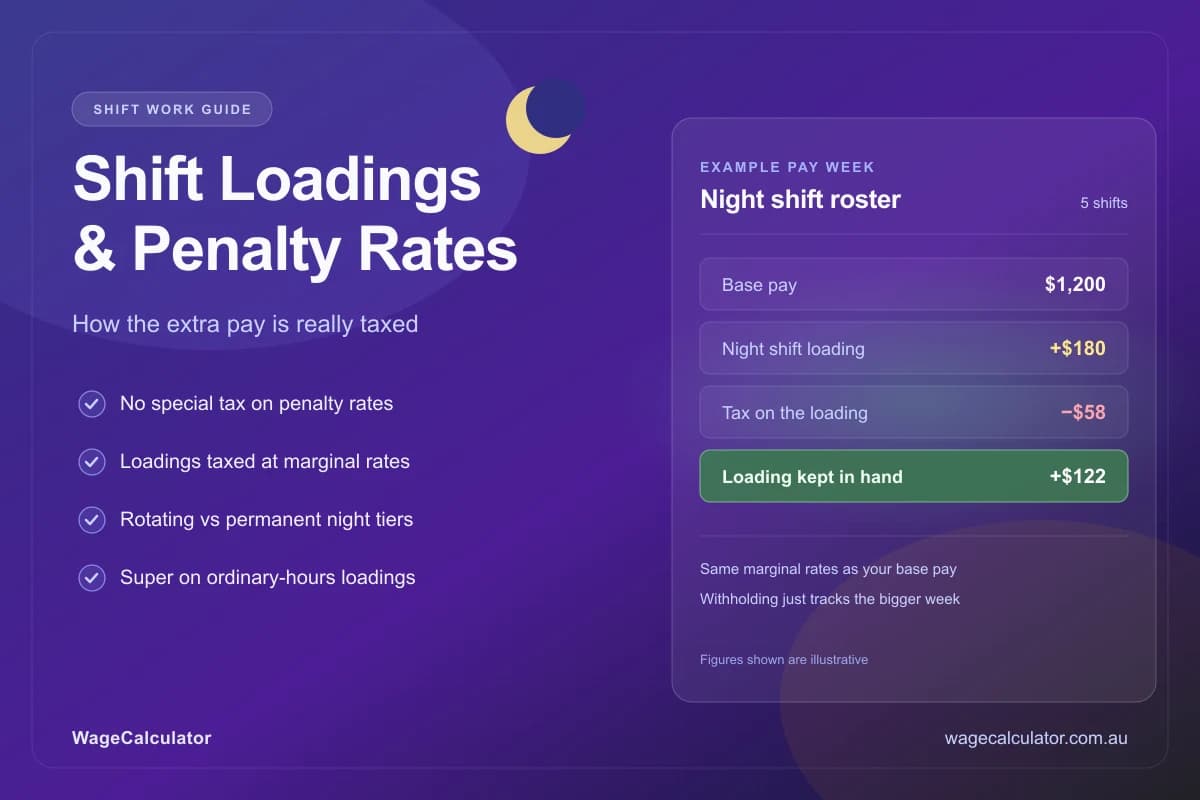
No. Shift loadings, penalty rates and casual loading are reported as part of your gross salary and wages and taxed at the same marginal rates as the rest of your income — the ATO has no separate tax schedule for shift or penalty pay. What is true is that the extra dollars sit at the top of your income, so they are taxed at the marginal rates that apply there, plus the Medicare levy — and a loading big enough to cross a bracket is split, with only the part above the threshold taxed at the higher rate. That is how marginal tax rates work for any extra income, from a pay rise to overtime — shift pay is not singled out.
Example (2026–2027): a nurse on $75,000 whose rostered hours all carry the award's 15% night-shift loading earns an extra $11,250 a year. Income tax and Medicare on that loading come to $3,600, leaving $7,650 in hand — about 68% of the loading kept. The take-home calculator shows this same kept-share figure for your own numbers.
Source: ATO — Withholding for allowances.
Why a big penalty week looks over-taxed
PAYG withholding works period by period: the ATO's formulas take your earnings for the pay period, convert them to a weekly equivalent, and withhold as if you earned that amount every week of the year. A week loaded with night shifts and Sunday penalties is withheld as though every week looked like that one. If your roster genuinely carries those penalties all year, that assumption is close to right and there is nothing to come back. It is the unusually big period — extra shifts, a covered swap, a run of public holidays — that is over-withheld against your actual annual position, and when your return is assessed on the real total, the difference comes back. The tax withheld calculator shows what one specific pay withholds.
Two common look-alikes are worth separating. A second job is often withheld without the tax-free threshold, which makes shift work for a second employer look heavily taxed — that is a withholding election, not a shift-work rule. And a bonus covering more than one pay period is withheld under a separate ATO schedule, while one tied to a single period uses the ordinary table — which is why a bonus can look over-taxed too.
Super on loadings and penalties
Employer super is calculated on qualifying earnings — the payday super base that applies from 1 July 2026. The ATO's list includes shift penalties (public holiday penalties included) and casual loading paid for ordinary hours, so a night-shift loading on your rostered hours attracts super. Overtime payments sit outside the base where your ordinary hours are clearly identified in an award or agreement — a genuine overtime penalty usually earns no super. Annual leave loading paid during employment is included unless it is clearly linked to lost overtime. The long-standing ordinary time earnings ruling was withdrawn when payday super began; the ATO's guidance is that the amount of super most employers pay stays the same.
The take-home calculator's shift loading card carries a toggle for exactly this split: switch it on for a loading paid on rostered ordinary hours, off for pay that is genuinely overtime, and the super line follows. Its label still reads ordinary time earnings — the term the withdrawn ruling used — but the test it applies, ordinary hours or not, is the one qualifying earnings uses as well.
Frequently asked questions
Is night shift allowance taxed?
Yes. A night shift loading or allowance is ordinary taxable income: it is added to your gross wages, withheld under the normal PAYG schedules and taxed at the same marginal rates as your base pay. There is no separate or higher tax rate for shift work — the loading changes how much income you earn, not the rate scale applied to it. In the take-home calculator you can add your loading and see the exact tax and take-home change for your own numbers.
Do you pay more tax if you work weekends or public holidays?
Not at a higher rate. Weekend and public holiday penalty rates are taxed exactly like ordinary pay — they raise your income, and the extra dollars are taxed at your marginal rate. A payslip from a heavy penalty week can still look over-taxed, because PAYG withholding works from the weekly equivalent of that period's earnings, as if you earned that much every week. The difference washes out when your return is assessed on the real annual total.
Is casual loading taxed differently from normal pay?
No. The 25% casual loading is part of your gross wage and is taxed at the same marginal rates as the base rate it sits on. It receives no concession and no penalty — you keep the same share of the loading as you keep of any other dollar earned at your income level. What the loading changes is your entitlements: it compensates for paid leave, notice and redundancy pay that casual employment does not provide.
Do casuals get casual loading and penalty rates at the same time?
It depends on the award. Some awards apply the casual loading and the penalty separately to the base rate and add them together; others publish a single combined casual rate for evening, weekend or public holiday work that already includes the loading — the Retail Award's casual penalty rates work that way. The two methods produce different pay, so check the penalty rates clause of your award or the Fair Work pay tools rather than assuming one pattern.
What does 17.5% loading mean?
That is annual leave loading — a different payment from a shift loading. It is an extra 17.5% paid on top of your base rate while you take paid annual leave, historically to compensate shift and weekend workers for the penalties they miss while on leave. Like shift loadings, it is taxed at your normal marginal rates. If you searched for it while checking a payslip, the annual leave calculator covers how it is worked out.
Is it illegal to not pay casual loading?
Where an award or registered agreement covers your job and you are engaged as a casual, the loading is an entitlement, not an optional extra — paying less than the base rate plus the loading is an underpayment and is recoverable. Employment contracts cannot trade it away below the award floor. If you believe you are not being paid correctly, raise it with your employer first and use the Fair Work Ombudsman's pay tools and help channels to check and pursue the shortfall.
Do shift loadings and penalty rates count for super?
Generally yes. Employer super is calculated on qualifying earnings — the payday super base that applies from 1 July 2026 — and the ATO's list includes shift penalties, public holiday penalties and casual loading paid for ordinary hours. Overtime payments sit outside the base where your ordinary hours are clearly identified in an award or agreement. So a night-shift loading on rostered ordinary hours attracts super, while a genuine overtime penalty usually does not.