


What is Debt Recycling?
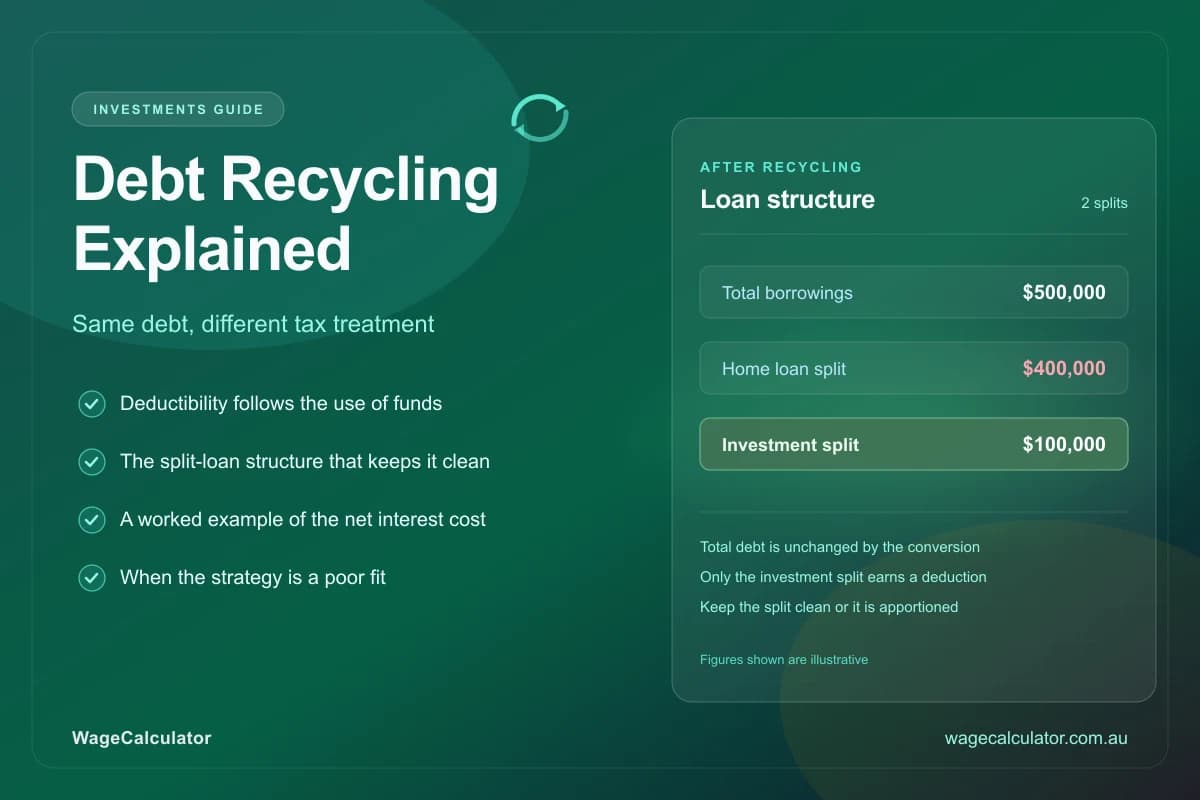
Debt recycling converts non-deductible home loan debt into deductible investment debt, without increasing how much you owe. You pay surplus cash into the mortgage, then redraw the same amount through a separate loan split and use it to buy income-producing assets. Total borrowings are unchanged. What changes is the tax treatment: interest on a loan used to buy your own home is private and not deductible, while interest on a loan used to buy income-producing assets is deductible against your assessable income.
Repeated each year with new surplus, the non-deductible balance shrinks while the deductible balance grows, until the whole loan has been converted. That progressive conversion — not a single one-off swap — is what practitioners mean by the term.
How It Works, Step by Step
The cycle has four steps, repeated as often as your surplus allows:
- Pay down the home loan. Direct surplus cash at the non-deductible balance.
- Create a separate split. Ask your lender for a dedicated loan account for the amount you just repaid — not a redraw from the main loan.
- Draw and invest. Use that split, and only that split, to buy income-producing assets.
- Put the proceeds to work. Dividends and the tax saving are surplus cash. Directing them at the remaining non-deductible balance accelerates the next cycle; reinvesting them instead compounds the portfolio faster.
Step four is what compounds the strategy, and the choice there is genuinely yours. Sending proceeds at the home loan converts the debt sooner; reinvesting them grows the portfolio sooner. The calculator models the reinvesting variant — after-tax dividends buy more units rather than paying down the loan — so its "years to fully recycle" reflects your lump sum and annual surplus alone, and is the conservative figure if you intend to redirect proceeds as well.
Why the Interest Becomes Deductible
Deductibility turns on the useof the borrowed funds, not on the asset securing the loan. This is the "use" test established in FCT v Munro (1926) and applied by the Australian Taxation Office in Taxation Ruling TR 95/25, which governs interest deductions under section 8-1 of the Income Tax Assessment Act 1997.
Two consequences follow, and both surprise people. Borrowing against your home does not make the interest private if the money buys shares — it is deductible. And borrowing against a share portfolio does not make the interest deductible if the money pays for a holiday. The security is irrelevant; the purpose is everything. That asymmetry is the entire basis of the strategy, and it is also why record-keeping matters so much: you must be able to demonstrate what the borrowed money actually bought.
A Worked Example
Take $100,000 recycled at a 6% loan rate, for someone in the 37% marginal bracket paying the 2% Medicare levy.
Example: Interest on the investment split is $6,000 a year. Because that interest is now deductible, it reduces tax by roughly $2,340 — leaving a net cost of about $3,660. The portfolio has to out-earn that net figure, not the full $6,000, for the strategy to pay off.
That gap is the whole point: the deduction lowers the hurdle rate. Dividends are taxed as they arrive, franking credits offset some of that tax at the 30% company rate, and a capital gain is taxed on sale — with the 50% discount, for a sale before 1 July 2027 of a parcel held longer than 12 months. For a sale from 1 July 2027 the enacted reform keeps that discount only for growth up to 30 June 2027 and indexes the cost base for later growth, with a minimum-tax comparison on top. The debt recycling calculator applies whichever regime its projected sale date falls under, and the capital gains tax calculator compares both regimes on the same gain.
The Split Loan Structure
Execution is where debt recycling goes wrong, and it almost always goes wrong the same way. The investment borrowing must sit in its own loan account, used once, for the investment purchase, and never again. Draw personal spending from that same split and it becomes a mixed-purpose loan.
The consequence is worse than a proportional haircut. Every repayment on a mixed loan is apportioned across the deductible and private portions — you cannot direct repayments at the private part alone. The contamination therefore persists rather than washing out, and untangling it usually means refinancing into fresh splits and losing the paper trail that supported the original deduction. Most lenders create splits for free on request, which makes this an entirely avoidable failure.
Is Debt Recycling Worth It?
It depends on two things: your marginal rate, and whether your investments clear the after-tax cost of the borrowing. The deduction is worth your marginal rate plus the Medicare levy on every dollar of interest, so someone in the 45% bracket captures far more than someone near the tax-free threshold. Below roughly the middle brackets the benefit rarely justifies the complexity and the risk.
The honest framing is that debt recycling does not generate returns. It lowers the after-tax cost of borrowing to pursue them, which improves the odds without removing the risk. A portfolio that returns less than the net interest cost still loses money — the deduction simply makes the loss smaller.
Debt Recycling vs the Alternatives
An offset account delivers a guaranteed, tax-free return equal to your loan rate, with the money instantly accessible. Debt recycling gives up that certainty for a tax deduction plus market returns. The two answer different questions: an offset asks whether to invest at all, while debt recycling asks how the borrowing should be structured given that you are investing. The invest vs offset calculator settles the first question.
Negative gearing is often confused with debt recycling but describes an outcome rather than a restructure — an investment whose costs exceed its income. You can debt recycle into a positively geared portfolio and never be negatively geared. Salary sacrificing into super is a third option worth comparing: it delivers a guaranteed tax saving rather than a leveraged one, at the cost of locking money away until preservation age.
When Not to Debt Recycle
Several situations make the strategy a poor fit, and recognising them matters more than optimising the arithmetic:
- Unstable income or no buffer. Converting accessible cash into an illiquid portfolio removes your margin for error.
- A low marginal rate. The deduction is the entire tax benefit, and it scales with your rate.
- A short horizon. Nearing retirement leaves too little time for returns to overcome the interest cost.
- No stomach for a drawdown. If you would sell in a deep market fall, the strategy will not survive one.
- A loan that cannot split cleanly. Without a segregated split the deduction is compromised from the start.
Frequently Asked Questions
Does debt recycling actually work?
It works when two conditions hold: your marginal tax rate is high enough that the interest deduction is worth something, and your investments return more than the after-tax cost of the borrowing. The mechanism itself is not speculative — converting non-deductible interest into deductible interest is settled tax law. What is uncertain is the investment return. Debt recycling does not create returns; it lowers the after-tax cost of borrowing to chase them. If markets fall, you still owe the investment split, and you have taken on real risk to capture a tax benefit.
Is debt recycling legal?
Yes. It relies on an ordinary application of section 8-1 of the Income Tax Assessment Act 1997: interest on money borrowed to produce assessable income is deductible. The Australian Taxation Office sets out the position in TR 95/25, applying the "use" test established in FCT v Munro. Nothing about the strategy is aggressive or a scheme — you are borrowing to invest, which the law contemplates. What attracts scrutiny is poor execution: a contaminated loan split, inadequate records, or claiming deductions on borrowings that were not actually used to produce income.
Is debt recycling the same as negative gearing?
No, though both involve deductible interest. Negative gearing describes an outcome — your investment's income is less than its costs, so the loss reduces other taxable income. Debt recycling describes a restructure — changing what existing borrowings are used for so their interest becomes deductible at all. You can debt recycle into a positively geared portfolio and never be negatively geared. The strategies do overlap: a debt-recycled portfolio that yields less than the loan rate is, in that year, negatively geared.
Can I fix a split I have already contaminated?
Usually only by refinancing into fresh splits, and you lose the clean paper trail that supported the original deduction in the process. There is no way to "repay the private part first" — that is precisely what apportionment prevents. If the contamination is recent and small, an accountant may be able to substantiate the original purpose from transaction records; if it has been running for years across many drawings, the practical answer is to establish new splits and treat the old balance as mixed from the start. Prevention is far cheaper than the cure.
Can I debt recycle using an offset account instead of redraw?
Not directly, and the distinction matters. Money sitting in an offset account is your own cash, so withdrawing it to invest does not create a borrowing — there is no interest to deduct. Redraw is different: repaying the loan and redrawing is a new borrowing, and its deductibility follows what you spend it on. The cleanest structure avoids both ambiguities by using a dedicated split rather than redrawing from the main loan. If your funds are currently in an offset, most lenders will let you pay down the loan and establish a separate investment split.
How long does it take to fully recycle a home loan?
It depends entirely on your surplus. A $100,000 starting amount plus steady annual contributions converts a typical mortgage over roughly a decade; a smaller surplus takes proportionally longer. The conversion is not the finish line, though — a fully recycled loan means all your mortgage interest is deductible, but you still owe the money and still carry the investment risk. The calculator on this site reports the number of years to full conversion for your own figures alongside the after-tax result.
Can I debt recycle into property instead of shares?
Yes — the tax principle is identical, since deductibility turns on whether the asset produces assessable income, not on what kind of asset it is. Property brings differences that change the arithmetic: entry costs including stamp duty, far lower liquidity, concentration into a single asset, and rental income rather than franked dividends. Shares suit progressive recycling because you can invest small amounts repeatedly; property generally requires one large transaction. Most people running the strategy incrementally use listed shares or exchange-traded funds for that reason.
Do all lenders allow loan splits?
Most mainstream lenders do, usually at no cost or a small one-off fee, and many allow several splits on a single property. What varies is the administration: some let you create splits online, others require a formal variation. Ask specifically for a separate loan account rather than a sub-account of your existing loan, and confirm the redraw from that split lands in an account you control before it reaches the broker or share registry. Check before restructuring — discovering your lender will not split cleanly after paying down the loan is an awkward position.