


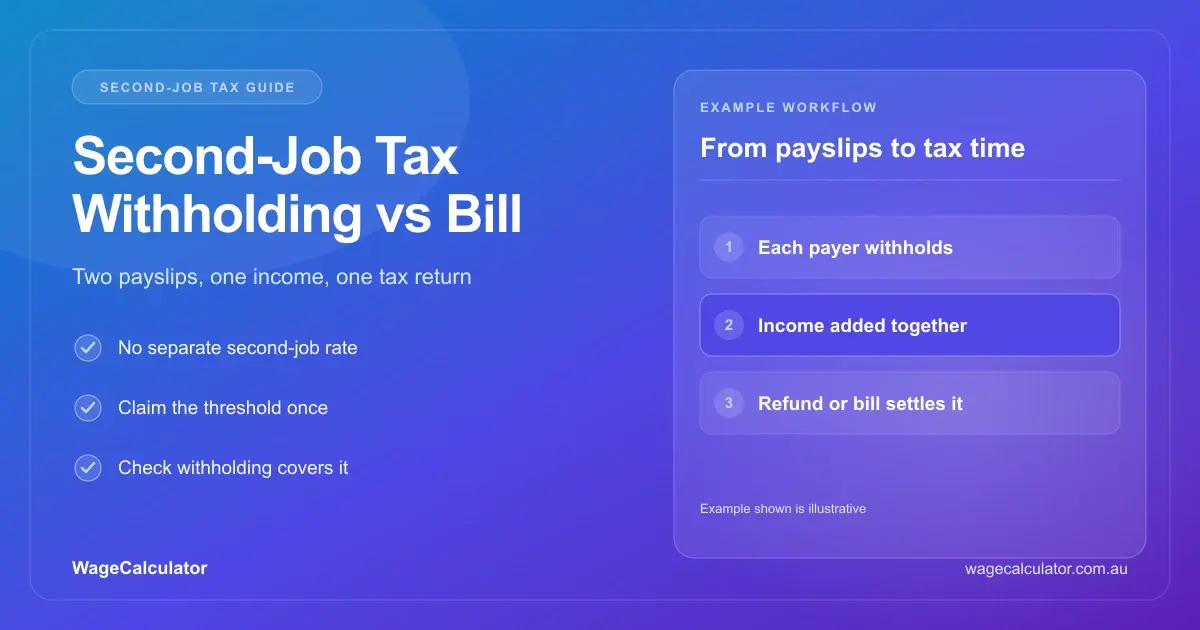
There is no second-job tax rate
A second job has no separate tax rate. Your pay from every job is added together and assessed once, at the ordinary resident rates, when you lodge. But each payer withholds tax from its own pay only, so even correct declarations on a $91,000 income from two jobs can leave about $3,252 to pay.
The first $18,200 is tax-free, and the top rate of 45% applies only to taxable income above $190,000, plus the 2% Medicare levy.
What does change is withholding: the tax each payer takes out of each pay. Each payer only sees its own payslip, so the second job is usually withheld at the “no tax-free threshold” rate from the first dollar. That can make the second payslip look heavily taxed, but it is a prepayment towards one annual bill, not a separate tax, and depending on your total income it can turn out too high or too low. The income tax guide explains the brackets.
Should you claim the tax-free threshold on a second job?
You answer the tax-free threshold question on the TFN declaration you give each payer. If your total income from all payers will be above $18,200, claim it from one payer only, usually the one that pays you the most, and answer “no” for every other job. That second payer then withholds at the higher no-threshold rate.
If you are a resident for the full year and sure your combined income will stay at or below $18,200, the ATO lets you claim the threshold from each payer, so little or no tax is withheld. Non-residents for the whole year cannot claim it, and part-year residents get a reduced threshold. If your income later rises, give one payer a withholding declaration to stop claiming it there. The same form can move the claim to a different payer, for example when your main job changes.
Source: ATO — Multiple jobs or change of job.
Withholding versus your final bill
The no-threshold rate is calculated from the second job's pay alone. It cannot see that your main job has already used the tax-free threshold and lower brackets, so it can withhold less than the extra tax that pay really adds. At lodgment the ATO adds up all your income and all the tax withheld: too much withheld becomes a refund, too little becomes a bill. The ATO's own multiple-jobs page includes a correctly declared taxpayer, with a pension and a part-time job, who ends the year owing tax.
Job 2 on its own payslip
In the example below, Job 2 pays $1,000 a fortnight and withholds $180 each pay, or $4,680 for the year. Added to Job 1, that pay raises the annual tax and Medicare levy by about $8,360, so you keep about $17,640 of the $26,000. That is about 32.2% of each extra dollar in this example.
Source: ATO — Schedule 1 statement of formulas and ATO — Multiple jobs: tax withheld from all income sources.
Worked example: one job versus two
One person earns $91,000 a year: Job 1 pays $2,500 a fortnight and Job 2 pays $1,000. The assessed tax is the same in the first three rows, because the income is the same. Only the withholding changes: one job ends with $388 refund, two correctly declared jobs with $3,252 to pay, the threshold claimed on both with $6,840 to pay, and a HELP debt on top with $6,323 to pay. To run your own two jobs through the same steps, use the second job tax calculator.
| Scenario | Withheld in the year | Assessed tax | At tax time |
|---|---|---|---|
| One job paying the same total | $19,708 | $19,320 | $388 refund |
| Two jobs, threshold claimed on the main job only | $16,068 | $19,320 | $3,252 to pay |
| Two jobs, threshold claimed on both | $12,480 | $19,320 | $6,840 to pay |
| Two jobs, threshold once, with a HELP debt | $16,068 | $22,391 | $6,323 to pay |
The standard deduction guide explains the deduction used in the assessed figures.
HELP and other income-tested amounts
Anything worked out on your income for the year uses the combined figure. Your compulsory HELP repayment is based on total repayment income, but each payer adds a study-loan amount only from its own pay. In the example, neither payslip carries any study-loan amount at these pay levels, yet the assessment adds about $3,071 in HELP repayment, leaving $6,323 to pay in all. That assumes your loan balance is at least that large; the repayment never exceeds what you still owe. Tell every payer about the loan on its TFN declaration, and expect a gap anyway.
The same applies to the Medicare levy surcharge and the low income tax offset: both use your income for the whole year, so a second job counts towards each one even though no single payslip reflects it. The Medicare levy surcharge guide covers the cover test.
Source: ATO — Why you may receive a tax bill and ATO — Study and training loan thresholds and rates; the per-payer study-loan amount follows ATO Schedule 8.
How to avoid a bill from two jobs
- Claim the threshold once. If you ticked “yes” at both jobs, give the lower-paying one a withholding declaration. It stops the shortfall growing; it does not refund what was already under-withheld.
- Ask for more to be withheld. An upward variation needs only a written request to your payer, or a withholding declaration through ATO online services. Unlike a downward variation, it does not need ATO approval. In the example, about $126 extra a fortnight would have covered the gap.
- Or set money aside. Estimate the year with the tax return calculator and save the gap, or make voluntary tax prepayments.
- Too much withheld? A downward variation needs an ATO application, and the ATO says to apply only when you are certain of your income.
Source: ATO — Varying your PAYG withholding and ATO — How to prevent a tax bill.
What to read off each payslip
To check where you stand mid-year, take these from the latest payslip for each job:
- Gross pay and tax withheld year to date, plus the pay cycle.
- Whether the tax looks like the threshold rate or the no-threshold rate — the tax withheld calculator shows both for any pay.
- Any separate study-loan amount, and salary sacrifice or allowances.
To plan ahead, the second job tax calculator shows what each payer should withhold and whether both jobs together point to a refund or a bill. To check the year so far, add both jobs' year-to-date income and tax withheld, project them to 30 June, and enter the totals in the tax return calculator. The tax refund guide explains the other reasons a refund or bill can differ.
Frequently asked questions
Is there a separate tax rate for a second job?
No. Your second job's pay is added to your other income and the whole year is assessed once, at the ordinary resident rates. You pay the same tax on $91,000 whether it comes from one employer or two. What differs is the amount withheld from each payslip during the year, because each payer works out withholding on its own pay only. That difference is settled when you lodge your tax return, as a refund or a bill.
Is a second job taxed at 47% or at half your pay?
Not on the ordinary withholding scales: no payslip withholds a flat half of your pay, and the top rate is reached only on high incomes. The exception is a payer who has no TFN from you. Unless you have claimed an exemption or told them you have applied for one, they must withhold 47% of every payment until you give them your TFN declaration. The top marginal rate of 45% plus the 2% Medicare levy applies only to the part of your total taxable income above $190,000, and it applies the same way with one job or two. A second payer withholds at the no-tax-free-threshold rate, which starts from the first dollar, so the payslip can look heavy. That is withholding, not a special rate, and the final assessment reconciles it.
Can I claim the tax-free threshold on two jobs?
Generally not. When your total income from all payers will be above $18,200, the ATO says to claim the threshold from one payer only, usually the one paying the most, and tell the others not to apply it. If you are a resident for the full year and sure your combined income will stay at or below $18,200, you can claim it from each payer. Non-residents for the whole year cannot claim the threshold at all, and part-year residents get a reduced one. If your income then rises, give one payer a withholding declaration to stop the second claim.
Why do I owe tax when I declared my second job correctly?
Because the no-threshold rate on your second payslip is worked out from that job's pay alone. It does not know your main job has already pushed you into a higher bracket. Each extra dollar is taxed at your marginal rate plus the Medicare levy, and at lower incomes it can also reduce the low income tax offset or phase the levy in, so the second payer can withhold too little. In this guide's example, correct declarations still leave about $3,252 to pay. You can ask a payer to withhold more to close the gap.
I claimed the tax-free threshold on both jobs. What should I do?
Give the lower-paying employer a withholding declaration saying you no longer claim the threshold from it, so it switches to the no-threshold rate from your next pay. That stops the shortfall growing, but it does not fix the tax already under-withheld. Estimate the likely bill now and set money aside, or ask a payer to withhold an extra amount for the rest of the year.
Does a second job change my HELP repayment?
It can. Your compulsory HELP repayment is worked out on your combined repayment income, not job by job. Each payer adds a study-loan amount to your withholding only from its own pay, so two moderate payslips can each sit below the point where that amount starts. Tell every payer about the loan on your TFN declaration. In this guide's example the HELP debt adds about $3,071 to the bill, assuming the balance is at least that large; the repayment never exceeds what you owe.
Do I have to tell my main employer about a second job?
For tax purposes, the new payer needs your TFN declaration, where you say whether to claim the tax-free threshold and whether you have a study loan. Your main employer's withholding does not change because you have another job. Whether your employment contract or award lets you take a second job is a separate question for that contract, not a tax rule.